

On 20 August 2026, Google gave every website owner something it has rarely handed out: a direct way to ask your audience to see more of you in Google's results. The embeddable Google Preferred Sources button lets readers mark your site as one they want to follow, right from your own pages. It is a small feature with big implications, and it arrives at the exact moment AI summaries are draining clicks from the open web. Here is what it does, how it got here, and how an Australian business should use it.
What is Google Preferred Sources?
Google Preferred Sources is a personalisation feature in Google Search. When you mark a site as preferred, Google shows more of that site's fresh content in your own results: in the Google Top Stories carousel, in Google Discover, and in Google News. It does not remove other sites from your results, and it changes nothing for anyone else. It simply tells Google "I trust this source, show it to me more often when it has something relevant".
Readers can manage their Google Preferred Sources picks on Google's source preferences page, or add a source on the spot by tapping the star icon next to the Top Stories header in a search. According to Search Engine Land, Google says over half of users who set the feature up choose four or more sources, so people are not picking one favourite and stopping. They are building a shortlist, and the question for your business is whether you are on it.
From US experiment to a button on your own site
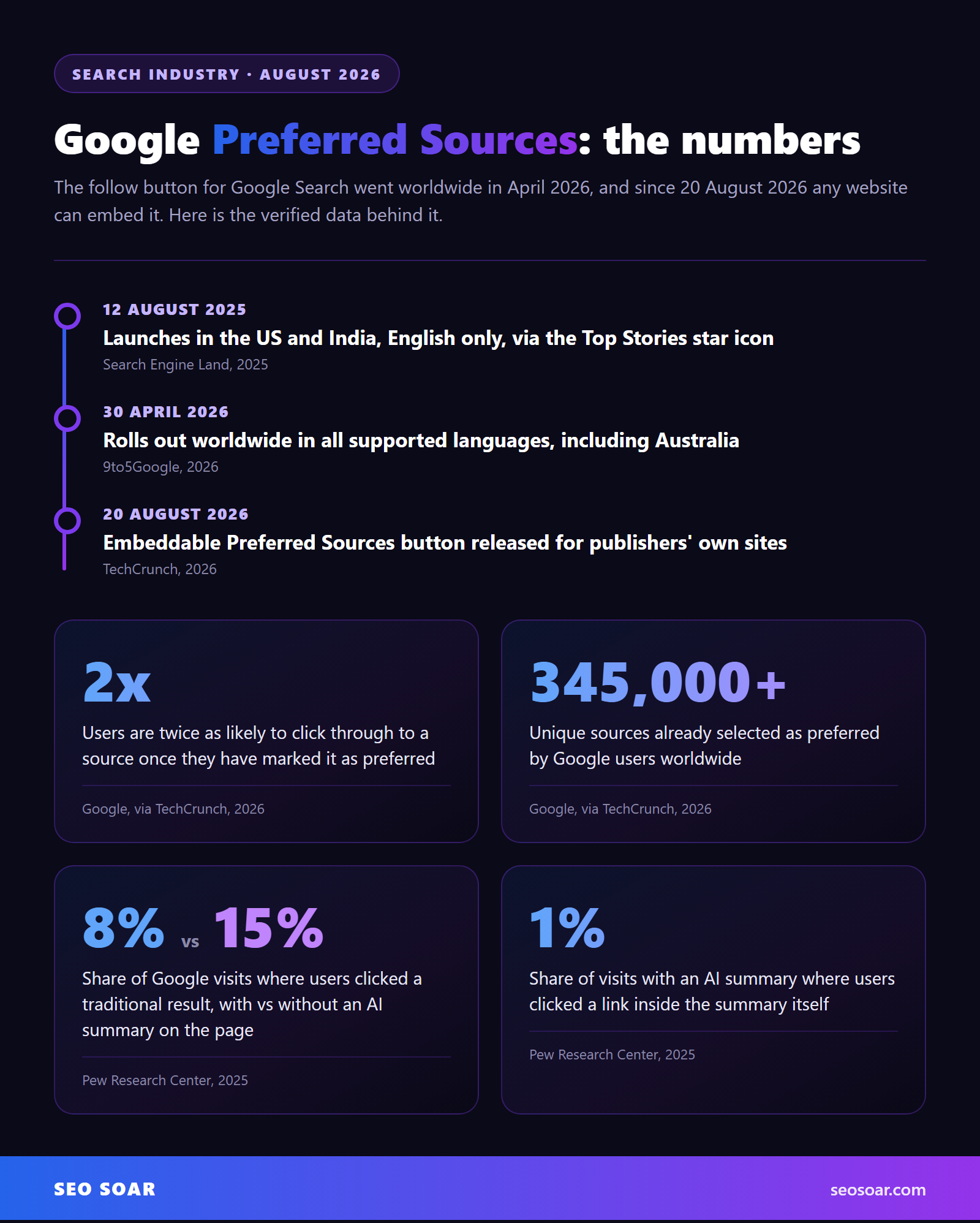
Google Preferred Sources has moved quickly. It launched on 12 August 2025 in the United States and India, English only, as a fairly quiet addition to the Top Stories box. Then on 30 April 2026, Google expanded it worldwide in all supported languages, which is the point it became fully available to Australian searchers and Australian sites. By then, more than 200,000 unique websites had already been marked as preferred by users.
The August 2026 step is the one that matters most for site owners. Google released an embeddable Google Preferred Sources button that any publisher can place on their own pages, so readers can follow you without ever hunting through Google's settings. TechCrunch reports that more than 345,000 unique sources have now been selected as preferred, and Google's own studies found users are twice as likely to click through to a preferred source when it appears. Google framed the launch plainly as a way for publishers to claw back traffic lost to AI-driven search features. That framing is worth pausing on: Google itself is acknowledging the problem.
Why Google built it: the zero click problem
The backdrop is the steady rise of zero click searches, where a person searches, reads what Google assembled on the results page, and leaves without visiting anyone's website. AI Overviews accelerated the trend. Pew Research Center's browsing study found that when an AI summary appeared, users clicked a traditional result on just 8% of visits, versus 15% when there was no summary. Clicks on the sources cited inside the summary were rarer still, about 1% of visits, and sessions were far more likely to simply end there: 26% versus 16%.
In other words, the average search is sending fewer people to websites than it used to, and we have covered what AI Overviews are doing to click-through rates in detail before. Google Preferred Sources is the company's partial answer. It cannot restore every lost click, but it creates a lane where loyalty beats the algorithm: the people who choose you keep seeing you, whatever the AI layer does to everyone else. For businesses worried about zero click searches eating their visibility, that lane is worth claiming early.
What Google Preferred Sources means for Australian businesses
It is tempting to file this under "news publisher problems", and most early coverage has talked about newsrooms. That would be a mistake. Any site that publishes fresh content regularly can benefit: a trades business with a working blog, an e-commerce store with buying guides, a professional practice publishing plain-English explainers. Fresh, relevant posts from your site are exactly what the feature is built to surface, and it feeds three placements at once: Search results, the Google Top Stories carousel when your content is timely, and your followers' Discover feeds.
Three things make Google Preferred Sources unusually attractive for small Australian businesses right now. First, almost nobody here is using it yet, so the button is a genuine early-mover opportunity rather than another crowded channel. Second, it compounds your existing audience: every reader, past client and email subscriber who follows you becomes a searcher who sees you more often, and Google's twice-as-likely click figure suggests that visibility converts. Third, it strengthens surfaces you cannot target directly. There is no bidding on Google Discover traffic and no guaranteed path into Top Stories, but a base of followers raises your odds in both, which has quietly made the button one of the more practical Google News SEO levers available. If Discover is unfamiliar territory, start with our guide to how Google Discover works.
A useful comparison is the social media follow. For a decade, businesses built audiences on platforms whose feeds decide who actually sees each post, and organic reach kept shrinking. A preferred-source follow is closer to permission you hold inside the search results themselves: when someone chooses your site, Google's stated design is to show them more of your fresh content, not less over time. No channel is guaranteed forever, but a follow that lives where people already search is a sturdier asset than one more social subscriber.
How to add the Google Preferred Sources button to your site
Getting set up takes an afternoon, not a project. Here is the sensible order.
- Check your site is findable. Open google.com/preferences/source, search for your business name and domain, and confirm your site can be selected. This page is also the fallback link you can send anyone.
- Add the button where loyal readers already are. Blog posts, your newsletter footer, thank-you pages after a purchase or enquiry. The point of the embeddable Google Preferred Sources button is meeting readers on your turf, so put it where goodwill is highest, not buried in a footer nobody scrolls to.
- Ask your existing audience. One email to your list and a mention on your socials explaining the one-tap follow will outperform waiting for organic discovery. People who already rate you will happily press a star.
- Keep publishing consistently. The feature surfaces fresh content from your site. If the blog last saw action in 2024, there is nothing for Google to show your followers. A steady rhythm of genuinely useful posts is what turns followers into recurring traffic, which is standard Google News SEO discipline applied to a new surface.
One honest caveat: Google has not published Australian-specific usage numbers, so treat Google Preferred Sources as a low-cost, high-upside addition to your strategy rather than a replacement for the fundamentals. Rankings, content quality and site health still decide most of your organic traffic.
Our take: claim the lane before your competitors do
We added the button across our own site and our clients' blogs because the logic is hard to argue with: it costs nothing, it takes minutes, and it converts audience goodwill into durable search visibility at a time when ordinary clicks are getting scarcer. Google Preferred Sources will not rescue a site with weak content, but for a business already doing the work, it is free compounding. If you want help setting it up, or you want to know how visible your business currently is across Google's AI-era surfaces, run our free AI visibility check or talk to us. We will give you a straight answer on where you stand.